Baterries
Japanese experts demand change to make phones and laptops safe
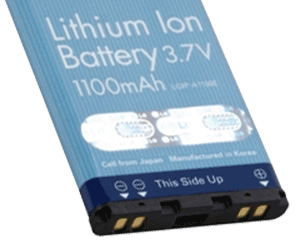 The fundamental technology behind the present generation of lithium-ion cells – the batteries that power nearly every laptop computer and mobile phone in the world – is inherently dangerous and must be changed to ensure safety, according to experts.
Masataka Wakihara, of the Tokyo Institute of Technology, who advises the Japanese Government on battery safety, told The Times that there must be changes to the way in which batteries are made if they are to be robust enough for everyday use.
His warnings were supported by comments from Kuniaki Tatsumi, head of the National Institute of Advanced Industrial Science and Technology’s battery research group, who said that “companies are less cautious about designing batteries with a focus on safety”.
At least two Japanese manufacturers are understood to be considering redesigns of their production lines as a result of Professor Wakihara’s advice, but in general companies are expected to resist calls to overhaul their factories. Although the commercial production of lithium-ion batteries began in 1992, when Sony became the first to enter the market, most battery production lines are young and have required substantial investment already, hence the difficulty in persuading their owners that a small number of battery explosions merits an expensive change.
“Battery companies are still learning because the technology is young, but there is a fundamental flaw with the way lithium-ion batteries are currently designed and if the companies genuinely care about safety, they need to completely change their production methods. A lithium-ion battery is quite a dangerous little box of energy,” Professor Wakihara said.
Last year Japanese companies produced around 60 per cent of the two billion lithium-ion batteries sold worldwide. Machines such as multi-function mobile phones, digital cameras and laptops equipped with processors large enough to cope with Microsoft’s new Vista program place huge demands on the batteries. According to Professor Wakihara, the risks of not adopting an alternative technology are rising constantly because of the demands that modern devices in a “mobile device culture” place on their power source.
“Efforts have been mainly devoted to miniaturisation and boosting power output,” Professor Tatsumi said.
The academics’ concerns emerged after a series of safety problems at the world’s three biggest battery manufacturers – Sony, Sanyo and, most recently, Matsushita (Panasonic), which has recalled 46 million mobile phone batteries made for Nokia after a handful of them burst into flames.
While the temptation has been to blame quality control at the factories where the batteries are made, Professor Wakihara said, the focus is wrong. The Japanese Government’s hasty creation of new battery safety standards fall into the same trap.
The recent recalls at Sony, Sanyo and Matsushita have arisen from problems during the manufacturing process, which led to short-circuits and other overheating issues, but it is possible, Tokyo Institute of Technology researchers say, to produce a lithium-ion battery that poses no fire risk, even if a fault develops. Existing lithium-ion batteries submerge the electrodes in an organic solvent that acts as the electrolyte, and separates them with a film of perforated plastic, which is expensive to produce. An alternative, chemical engineers argue, is to encase the electrodes in a solid polymer electrolyte – a structure that might have to be heated slightly to ensure good function.
Within the past fortnight, Sony has announced a battery plant in Singapore that would use new technology, but it would not say whether this represented the kind of shift that Professor Wakihara is calling for.
(Published by Times Online, August 21, 2007)
_________________________