France
Rail network hit by sabotage as radicals try to wreck peace talks
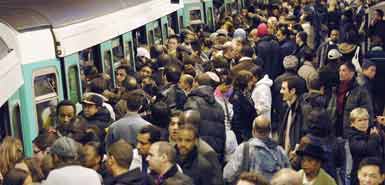 Saboteurs raised the stakes in the stand-off over President Sarkozy’s reforms yesterday, staging a series of attacks on France's high-speed rail network that further disrupted services already crippled by a week-long transport strike.
Vandalism to signal systems around Paris, Lille and other cities delayed TGV express trains for up to three hours, adding to disruption from the strike on the SNCF railways and the RATP Paris transport authority. The Eurostar cross-Channel service was not affected.
All sides denounced the attacks — in which dozens of yards of cables were burnt and burning rags were jammed into switching systems — as criminal and dangerous. Mr Sarkozy called for the culprits to be punished with the “utmost severity”.
“Co-ordinated acts of sabotage have been committed,” François Fillon, the Prime Minister, told parliament. “Those who committed them will not get away with it. The punishment will be heavy.” With the crisis costing France about €400 million euros (£290 million) a day, according to government estimates, Eric Woerth, the Civil Service Minister, said that the sabotage was political and designed to thwart talks aimed at reaching a resolution. “They way the acts were aimed at strategic points leaves no doubt that the aim was to slow down the return of services, hinder passengers and stop negotiations running smoothly,” he said.
The sabotage happened just before the employers, unions and the Government opened talks to find ways of compensating the public sector workers for giving up their longstanding right to early retirement.
Mr Sarkozy is deemed now to have won acceptance for this politically loaded reform but a minority, which include many train and underground drivers, is holding out. Four-fifths of transport employees were back at work yesterday but fewer than half the normal services were running, mainly because many drivers are still fighting to keep their retirement age of 50.
Hardline strikers accused provocateurs of staging the sabotage to discredit them by fuelling anger over the chaos inflicted by the stoppages.
Christian Mahieux, boss of the Trotskyite Sud-Rail union, which is supported by 14 per cent of railway workers, insisted that no railwaymen would have committed the sabotage. France should ask: “Who profits from the crime?”, he said. Mr Mahieux has emerged as the figurehead of the die-hards who are refusing any compromise with Mr Sarkozy’s plan to end their privileges. He insisted that his members would stop striking when Mr Sarkozy abandoned his reform and granted early retirement to the whole working population.
Such ultra-radical discourse is backed by an anti-capitalist fringe that survives more in France than elsewhere but it embarrasses the mainstream unions that now want to save their fire for Mr Sarkozy’s more vulnerable plans next year.
Libération, the main left-wing daily, said that the Sud-Rail cause might be deemed noble, but they were out of touch with public opinion. They risked “consigning themselves to splendid all-or-nothing isolation, which in the end will play into the hands of Sarkozy”.
Hailing Mr Sarkozy for winning his fight, Le Figaro said: “In the last few days the strike has fundamentally changed in nature. It is no longer the rank-and-file refusing to work, but the hardliners who from the start refused to countenance negotiation.”
All the unions are ready to resume their strikes if a planned month of negotiations does not win enough concessions. The Government has suggested salary rises and top-up pension schemes to soften the end of early retirement. The SNCF management is offering a €90 million a year financial package to compensate for the extra two and a half years that staff will be required to work.
The public has been largely behind Mr Sarkozy over the transport workers, but the strikes have added to a sense that life has not improved since the election in May of “Super-Sarko” on his promises of a French renaissance. Laurence Parisot, the head of Medef, the main employers’ federation, called the strikes a disaster yesterday. “I compare it to an earthquake. The economic cost is incalculable and likely to be gigantic,” she said.
Mr Sarkozy is facing growing discontent over a failure to fulfil election promises to put more spending money in French pockets. Opinion polls show that about 80 per cent of the French believe that he has yet to deliver on this.
Frustration with the rising cost of living helped to spur a national one-day strike by civil servants on Tuesday. Mr Sarkozy is expected to try to sweeten the sour national mood with a “Christmas package” of tax concessions before leaving for China at the weekend.
Fighting talk
— The word “sabotage” derives from the word “sabot”, a clog made from a block of wood that has been hollowed out
— It is said that striking French workers with Luddite tendencies would drop their shoes into machinery to stop production
— It is likely that the word comes from less romantic roots — the clunkiness of the peasants’ wooden shoes meant that “sabot” was often used to refer to clumsiness
Sources: Collins Dictionary; Etymonline.com
(Published by Times Online, November 22, 2007)
______________________