Air Crisis
Authorities criticized over handling of air crisis
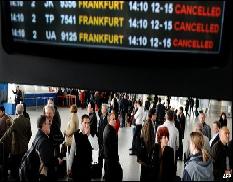 With little prospect of an early reopening of some of Europe’s busiest airportson Monday, governments faced growing criticism over their seemingly ponderous response to five consecutive days of flight chaos, and stranded passengers waited anxiously for word of when they might continue their journeys.
The International Air Transport Association, an airline industry group, criticized what it called a "lack of leadership" by European governments faced with an aviation shutdown on an unparalleled continental scale caused by high-altitude ash billowing from an erupting Icelandic volcano. The disruption has spread far and wide, from Kenyan roses, usually air freighted to Europe, to British troops stuck in transit from tours in Afghanistan.
The airport at St. John's, Newfoundland, became the first in North America to be affected by the volcanic ash plume late on Sunday. Flights were delayed or canceled to the airport near Canada’s easternmost tip after government officials anticipated that some of the ash may be drifting towards it.
A spokeswoman for the airport told the Canadian Broadcasting Corporation that Canada's transportation department and its air navigation system estimated that there was a 30 percent chance of the ash reaching the St. John's airspace.
Because the city hosted the Canadian music industry's awards ceremonies over the weekend, several prominent musicians, record industry executives and politicians were affected by the precautionary closing.
A decision about reopening the airport was expected on Monday morning.
Across the Atlantic, the British government said it was deploying the Royal Navy to bring people home, as the National Air Traffic Service announced that British airspace, closed since Thursday, would remain closed until at least early Tuesday.
European transportation ministers scheduled an emergency meeting on Monday in Madrid, but some ministers were only able to participate only by videoconferencing because they were grounded at home.
Most of Asia's largest carriers continued to cancel their flights into Europe, adding to the financial cost of the chaos, which one industry group estimated at $2 billion and climbing.
French, German and Dutch airspace also remained closed, although several major airports in southern Europe — notably Rome, Athens and Madrid — were operating. Airports in the Czech Republic opened at noon local time, according to the Czech news agency, and news reports said that Slovakia was allowing flights over the eastern part of the country.
Aviation authorities in Hungary announced they had reopened the country's airspace for aircraft flying at 24,600 feet or higher.
Eurocontrol, the Brussels-based agency that coordinates air-traffic management across the region, said that only 8,000 or 9,000 of the continent’s 28,000 scheduled flights would operate on Monday.
"We are far enough into this crisis to express our dissatisfaction on how governments have managed it, with no risk assessment, no consultation and no leadership," said Giovanni Bisignani, the director general and chief executive of the International Air Transport Association. “This crisis is costing airlines at least $200 million a day in lost revenues and the European economy has already suffered billions of dollars in lost business.
Willie Walsh, the chief executive of British Airways, said the region’s carriers had approached the European Union and their national governments seeking financial compensation for the airspace closures.
"There is a precedent for this to happen as compensation was paid fter the closure of U.S. airspace following the terrorist events of 9/11, and clearly the impact of the current situation is more considerable," Mr. Walsh said in a statement.
British Airways estimated that the disruptions from the volcanic ash cloud were costing the airline between £15 million and £20 million, or $23 million to $31 million, a day in lost passenger and cargo revenue as well as expenses related to supporting stranded passengers. The company stressed that it had sufficient financial resources to weather a prolonged closure of British airspace, however.
Other broader estimates of the economic toll went much higher.
"The Ash Attack has already affected the travel plans of 8 million passengers in Europe and around the world," the Center for Asia Pacific Aviation, a consultancy based in Sydney, said Monday on its Web site. "The total cost for the aviation industry (airlines, airports, suppliers, freight operators, handlers, etc.) could be well over $2 billion."
Several European airlines, the center said, were already considering emergency layoffs.
The airport in Vienna officially opened at 5 a.m. Monday, although the arrivals and departures board showed that most flights remained canceled. The airport in Stockholm also opened with limited service.
Italian authorities opened the country's principal northern airports, in Milan and Venice, at 7 a.m., but then closed them again two hours later, citing new and ominous weather reports, according to the ANSA news agency. Vito Riggio, the head of the civil aviation authority, said the airports would stay closed until at least 8 a.m. on Tuesday. But airports in Rome and the south of the country were open.
Many Asian carriers canceled their flights to European destinations. Over the weekend, increasingly desperate airlines — among them Air France, Lufthansa, KLM and Air Berlin — ran test flights to show that flying was safe, and they pressed aviation authorities to loosen the ban.
Mr. Bisignani of the International Air Transport Association told reporters in Paris that he hoped the chaos will lead to a new momentum on discussions about a unified air traffic control system in Europe, known as the Single European Sky, which have been going on for 20 years.
"This is really a failure of Europe," he said. While Europe has been able to remove borders on the ground, he added, "we haven’t been able to take away the borders in the sky."
In its statement on Monday, the International Air Transport Association criticized the region’s decision-making process for closing airspace. "This not an acceptable system, particularly when the consequences for safety and the economy are so large," Mr. Bisignani said of the methodology, which is based on computer models.
But European governments seemed divided.
The Dutch transportation minister, Camiel Eurlings, said in an interview Monday with public broadcaster NOS that Europe’s response to the ash cloud had gone too far.
But on Sunday the British transportation secretary, Andrew Adonis, had ruled out any immediate change, saying flights across northern Europe "will not be safe" on Monday.
Prime Minister Gordon Brown said Monday that British authorities would deploy two Royal Navy vessels, including the Ark Royal aircraft carrier, to help bring Britons home.
He spoke after a meeting of the Cobra planning committee, which gathers in times of national emergency (the name stands for Cabinet Office Briefing Room A).
Britain is particularly isolated because the country is cut off from continental land routes by the English Channel. London’s main airport, Heathrow, is one of the busiest hubs in the world. And with Britain in the throes of political fervor before a national election on May 6, the government’s handling of the crisis will be closely scrutinized by its opponents for missteps, political analysts said.
Mr. Brown said Britain was looking to Spain, where airports are open, as a potential transit point to get Britons home by ferry, road and rail, but he did not say exactly what part the navy vessels would play.
Tens of thousands of Britons stranded outside the country include school-teachers and pupils, supposed to be back in their classrooms on Monday after a vacation break.
The crisis could wipe out weaker air carriers if it continues much longer, analysts say. Airlines have already suffered losses of $50 billion over the last decade after the attacks of Sept. 11, 2001, the SARS epidemics of 2004, the rise in fuel costs in 2008 and the recession.
Authorities are concerned that if an airplane moves through the ash cloud, which contains high levels of silica, a glasslike dust, the engines could seize or stall. But the airlines that sent up test flights on Sunday said they saw no damage to their planes. Complicating any decisions is the continued eruption of the volcano, Eyjafjallajokull.
While much of northern Europe’s airspace remained closed, the airport in Reykjavik, Iceland’s capital, was still open for business since southern winds were pushing ash away from the small rocky island in the North Atlantic.
(Published by The New York Times - April 19, 2010)