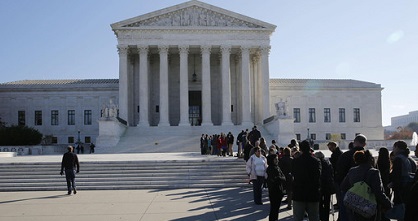
 Cases headed to the Supreme Court can be a long time in the making, and that’s especially true for a 16-year-old trademark law battle the justices took up Tuesday over phonetically identical names for brands of screws.
After an hourlong oral argument, it appeared possible the high court could issue an eventual ruling that would lead to even more litigation between two companies that are bitterly at odds in the case.
The case has its roots in a dispute born in the late 1990s. The plaintiff is B&B Hardware Inc., a Southern California business that sells self-sealing, leak-proof screws and bolts under the brand name Sealtight. Its products have been used in high-tech environments, including in the aerospace and medical industries. It alleged consumers were confused, and its business damaged, by a Texas company that sold construction screws under the name Sealtite Building Fasteners.
Sealtite says its brand doesn’t cause confusion with Sealtight because it sells different types of products to different classes of customers.
The justices took the case to consider the interplay between cases in federal court and at the U.S. Patent and Trademark Office, which both have taken turns hosting legal proceedings in the screw fight.
Sealtite has been on the winning side of two jury verdicts and a judge’s finding that opponent Sealtight tried to manufacture evidence to bolster its claims for trademark infringement. But B&B’s Sealtight, which registered its trademark first, won a ruling from a trial board at the Patent and Trademark Office that said Sealtite couldn’t register its mark because it would create confusion. B&B wants the Supreme Court to require that the Patent Office’s findings be given effect in the federal court case.
Several justices seemed open to that argument Tuesday.
Justice Sonia Sotomayor said that if the Patent and Trademark Office proceedings weren’t given some weight in a subsequent court case, it would render the administrative agency’s process “almost irrelevant.” Justices Antonin Scalia and Elena Kagan, meanwhile, voiced resistance to arguments from Sealtite that Patent and Trademark Office proceedings shouldn’t count in court because the agency considered different factors in its deliberations.
Justice Kagan said the agency’s analysis in the screw case was “loaded with stuff” on the same issues that were a focus of the later federal court litigation.
The Obama administration argued in favor of B&B, saying courts should give force to findings by the Patent and Trademark Office.
If B&B’s Sealtight prevails at the high court, the decision could revive its lawsuit because a jury decided the confusion issue for itself without deferring to the Patent Office proceedings.
Despite the court’s sometimes-skeptical questions of Sealtite, the outcome of the case wasn’t entirely clear. Justice Ruth Bader Ginsburg was vocal in support of the Texas company, saying Patent Office findings shouldn’t have controlling effect when later trademark litigation in federal court involves higher stakes for the businesses involved. “It seems to me this is such a case,” she said.
Chief Justice John Roberts floated the possibility of a middle-way approach that would give agency proceedings weight in federal court in some, but not all, circumstances.
A decision is expected by the end of June.
(Published by The Wall Street Journal – December 2, 2014)