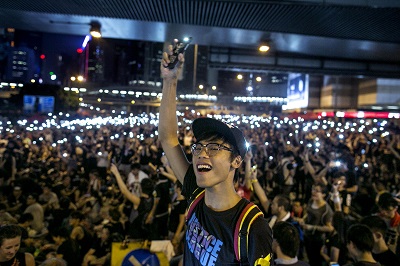
 Hong Kong’s two-month street occupation hasn’t damaged the Chinese city’s rule of law, according to Leonard Hoffmann, a visiting judge on the former British colony’s Court of Final Appeal.
“In every society there is room for points to be made by civil disobedience,” he said today, citing the example of the suffragettes who won British women the right to vote in the early 20th century.
Student-led protesters have occupied streets in Hong Kong over the past two months and occasionally clashed with police in their campaign to oppose China’s decision to vet candidates for the city’s next chief executive election. At least 40 people were arrested after an attempt to surround government offices early Monday morning and 65 protesters have surrendered to police for taking part in illegal street demonstrations as of last night.
“I don’t think either side has exceeded the bounds of the fair rules of the game” for civil disobedience, said Hoffmann, after giving a talk on arbitration and rule of law.
Those rules are: protesters avoid creating mayhem, and authorities and courts recognize acts of conscience and take that into account when it comes to punishment, he said.
Hoffmann, who has served on Hong Kong’s top court since 1998, said he couldn’t think of anywhere else in the world apart from Hong Kong that had an established independent judiciary and human rights without having democracy.
Asked for his thoughts on Singapore, he said he didn’t see anything to choose between the two cities as an arbitration venue as far as rule of law is concerned. Singapore has been boosting its arbitration services and is starting a new international commercial court with foreign judges.
“I do think the (Hong Kong) Court of Final Appeal is of higher caliber than Singapore’s Supreme Court,” he said.
Britain’s top judge David Neuberger, who also serves on Hong Kong’s top court, said in August that it is always right to be vigilant to protect rights and liberty, and that he would speak out or resign from Hong Kong’s top court if he felt the independence of judges in the city was being threatened.
(Published by Bloomberg – December 4, 2014)