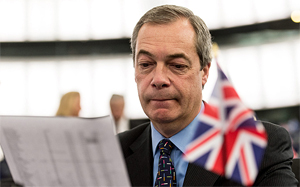
 Nigel Farage has resigned as leader of the UK Independence party, raising questions about whether Britain’s leading anti-immigration force can maintain its momentum without its only household name.
Mr Farage cited the personal stress of the role, saying he had “done his bit” in campaigning for Brexit and now wanted “his life back”.
His decision means that Ukip must seek to capitalise on its referendum victory without the leader who almost single-handedly transformed it into the UK’s third most popular party by votes. But it could also allow a new electoral strategy, focused on working-class Labour seats in the north and Wales.
“[The resignation] is possibly the best way of achieving the party’s renewal,” said Rob Ford, a politics professor at the University of Manchester. “They have to decide what they’re for now, apart from immigration [controls]?…?They can’t play both protectionist line and the ‘we’ll be better with free trade’ line.”
Mr Farage called for immediate exit negotiations with the EU, and said that, if the eventual deal did not end free movement, Ukip would make significant gains at the 2020 general election.
He is the second leader of the Leave campaign to retreat from front-line politics in recent days. Boris Johnson, the former mayor of London, shocked Westminster last week by dropping out of the battle to lead the Conservative party — and become the next UK prime minister — after former ally Michael Gove said he would stand against him.
Since Mr Farage first became leader in 2006, Ukip has grown from a ragtag army — dismissed by David Cameron as “fruitcakes, loonies and closet racists” — to a major constraint on the established parties.
It won 3.9m votes in last year’s general election, more than the Liberal Democrats and the Scottish National party combined, but those translated into only one MP.
“I think there’s a huge opportunity full-stop — especially in those working class Labour areas,” said Paul Nuttall, the deputy leader and a likely candidate to succeed Mr Farage.
Mr Nuttall argued that Labour could not attract northern voters if it split into a “far-left Islington set” led by Jeremy Corbyn and a centrist “Lib Dem light” party.
Other potential leadership candidates include Steven Woolfe, Ukip’s immigration spokesman, and Nathan Gill, its leader in Wales. Suzanne Evans, who wrote the party’s 2015 manifesto but then fell out with Mr Farage, is currently ineligible, having been suspended from the party. Douglas Carswell, the party’s sole MP who has also fallen out with the leader, said he would not stand.
Yet the new leader — who is expected to be announced by early September — is unlikely to generate the media attention that Mr Farage has earned through his pint-drinking bonhomie and insult-laden speeches to the European Parliament.
Mr Farage said he would serve out his term as a member of the European Parliament, and was open to playing a role in Britain’s negotiating team for Brexit. That could allow him to continue as a satellite to the new Ukip leader, as Alex Salmond has done in the SNP.
“He is likely to be a thorn in the side of whoever is the leader,” said Manchester university’s Mr Ford.
Ukip’s future electoral appeal is likely to depend on whether Brexit negotiations satisfy public discontent around immigration and unaccountable elites. The party has seen battles over those who focus on immigration and oppose the EU’s proposed Transatlantic Trade Partnership with the US, and those, like Mr Carswell, who embrace a more libertarianian, free-trading ethos.
In his resignation speech, Mr Farage said Ukip was financially sound, but needed to reform its management structures after years of continual electioneering. “The party is in a pretty good place — certainly compared to all the others,” he joked, referring to the divisions in the Conservatives and Labour.
Mr Farage was first elected to the European Parliament in 1999. He has led Ukip since September 2006, except for a hiatus in 2009-10.
He resigned as leader after the 2015 general election, having failed to be elected as an MP for the seventh time, only to reverse the decision days later.
“I won’t be changing my mind again, I promise you,” the former commodities trader told a press conference in London on Monday. “I’m not a career politician?…?“The real me will now come out.”
Since the referendum result, leading Conservatives — including Mr Johnson and Mr Gove — have distanced themselves from Mr Farage, who was criticised during the campaign for a poster that featured Syrian refugees.
On Monday Mr Farage laid claim to the Leave campaign’s victory: “I do believe myself that it’s Ukip and Ukip’s messages that inspired non-voters to go out there and make the difference. Without Ukip, there is no way that the Leave vote would have got over the line.”
Asked if he had any regrets, he replied: “The only people in life who make mistakes are the people who do things. And I do things.”
Farage in his own words
"I’m morbidly xenophobic about this new country called the European Union." 2001
"Any normal and fair-minded person would have a perfect right to be concerned if a group of Romanian people suddenly moved in next door." May 2014
“[Britain’s population] is going through the roof chiefly because of open-door immigration and [that means] the M4 is not as navigable as it used to be.” December 2014
“I’m a man of word. I don’t break my word.” Resigning as Ukip leader, May 8 2015
“There was only one person the NEC wanted for the job, and the party membership was in support.” Returning as Ukip leader, May 11 2015
“I love Europe! France is wonderful. It should be. We’ve subsidised it for 40 years.” April 2016
“You all laughed at me. Well, I have to say, you’re not laughing now, are you?” Speech to European Parliament, June 2016
(Published by Financial Times - July 4, 2016)