WikiLeaks founder Julian Assange was expelled from his hideout in Ecuador’s embassy in London Thursday and promptly arrested by London police on U.S. extradition charges.
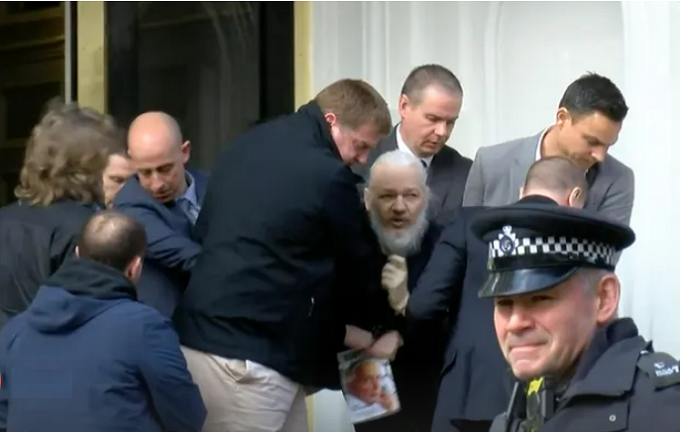
Assange was arrested moments after Ecuadorian President Lenin Moreno said on Twitter that the country had withdrawn his diplomatic asylum. Video showed a handcuffed and disheveled Assange being dragged out of the embassy and placed in a police van.
Assange’s lawyer, Jen Robinson, said the American warrant related to an alleged conspiracy with U.S. Army soldier Chelsea Manning in early 2010 in addition to separate charges for skipping bail in the U.K.
The 47-year-old has been in the Ecuadorian embassy since 2012 when he sought to escape questioning in a Swedish sexual-assault case. While those charges were dropped in 2017, Assange has remained in the small London apartment as he has continued to dodge U.K. police and American prosecutors.
Assange’s exit from the embassy ends a nearly seven-year standoff between the controversial transparency advocate and British authorities. While he will initially face punishment for jumping bail, Assange faces a lengthy extradition battle over the U.S. charges.
"Julian Assange is no hero and no one is above the law," U.K. Foreign Minister Jeremy Hunt said on Twitter. “He has hidden from the truth for years."
WikiLeaks said on its Twitter feed that Ecuador had “illegally” terminated Assange’s asylum.
London police said Assange was taken to a nearby station and will appear at Westminster Magistrates Court. The police said in a statement that they were invited into the embassy.
Assange will almost certainly be denied bail, given his previous flight to the Ecuadorean embassy, according to Nick Vamos, former head of extradition at the Crown Prosecution Service and a partner at Peters & Peters.
"The chances of getting bail are less than zero," Vamos said by phone.
Assange’s relationship with his Ecuadorian protectors has deteriorated over the years. He has had spats over Internet access and even faced criminal charges for hacking into the embassy’s computer system. On Wednesday, WikiLeaks officials held a press conference where they accused Ecuador of spying on Assange.
"The discourteous and aggressive behavior of Mr. Julian Assange, the hostile and threatening declarations of his allied organization, against Ecuador, and especially the transgression of international treaties" meant the situation is "unsustainable and no longer viable," Moreno said in a video message posted Thursday on Twitter.
Moreno said he’d wrung a guarantee from the U.K. that Assange wouldn’t be extradited to a "country where he would face torture or the death penalty," according to a transcript of the video message.
WikiLeaks and Assange became famous in 2010 when the organization published government secrets supplied by Manning. More recently, the website put itself at the center of the 2016 American presidential race by publishing hacked emails from Hillary Clinton’s campaign.
While the American case is still sealed, U.S. prosecutors in court filings last year may have inadvertently revealed that Assange had been charged. In a matter unrelated to Assange, federal prosecutors in Virginia, said that "no other procedure is likely to keep confidential the fact that Assange has been charged."
It’s still possible that Swedish prosecutors could resume their investigation, with a lawyer for the alleged victim of the assault saying last week that she will continue to fight for Assange to be extradited to Sweden. The Swedish Prosecution Authority said Thursday’s arrest was "news to us too."
Timeline
Here is a timeline of the key dates in the WikiLeaks founder’s case:
2010
31 August: Swedish police question Assange about two separate allegations – one of rape and one of molestation – which he denies.
18 November: An international arrest warrant is issued so Assange can be questioned on suspicion of rape, sexual molestation and unlawful coercion.
7 December: Assange presents himself to police in London and is remanded in custody after a hearing.
16 December: He is later granted conditional bail at the high court, bankrolled by his supporters who pay £240,000.
2011
2 November: Assange loses an appeal to extradite him to Sweden; a judge denies it would violate his human rights.
2012
19 June: Assange enters the Ecuadorian embassy in London, requesting political asylum. Scotland Yard confirms he is subject to arrest for breaching his bail conditions.
16 August: He is granted political asylum by Ecuador.
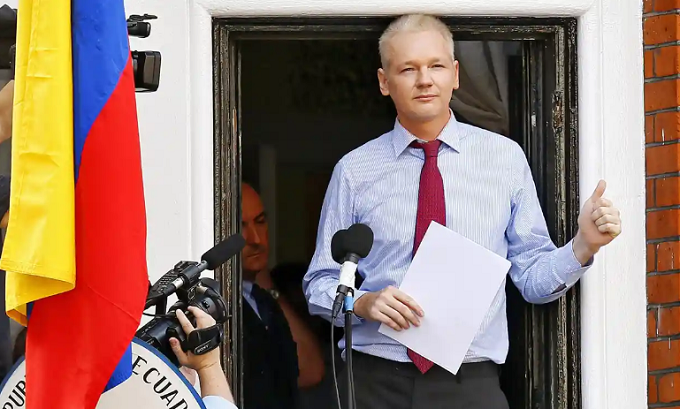
19 August: Assange emerges on the Ecuadorian embassy’s balcony and calls for the US government to “renounce its witch hunt” against WikiLeaks.
20 December: He again appears to say “the door is open” for talks to avoid extradition to Sweden.
2013
13 June: Assange tells journalists he will not leave the embassy even if sex charges against him are dropped, due to fears he will be extradited to the US.
2014
16 July: A judge in Stockholm upholds the arrest warrant against him for alleged sexual offences against two women. He later loses an appeal.
2015
13 March: Swedish prosecutors ask to question him at the embassy.
13 August: Investigations into some of the sex allegations are dropped due to time restrictions. The investigation into suspected rape remains active.
16 August: The UK Foreign Office minister Hugo Swire says Ecuador’s decision to harbour Assange in its embassy has prevented the proper course of justice. He restates the UK’s legal obligation to extradite him to Sweden.
12 October: The Metropolitan police end their three-year long, 24-hour guard outside the embassy. It is estimated to have cost more than £12m.
2016
5 February: The UN working group on arbitrary detention says Assange is being "arbitrarily detained", and calls on authorities to end his “deprivation of liberty”. The following month, the UK government asks for a review, saying the opinion was “deeply flawed” – this is later rejected.
20 June: Ecuador reveals the Swedish authorities have officially requested to interview Assange.
9 August: Assange files an appeal to a Swedish court, arguing the country must comply with the UN working group’s findings.
14 November: Assange is questioned over the remaining sex allegation at the Ecuadorian embassy by Swedish authorities in a two-day interview.
2017
17 January: Barack Obama’s decision to free the whistleblower Chelsea Manning prompts speculation Assange will end his self-imposed exile.
19 January: Assange tells a press conference that he stands by his offer to go to the US, provided his rights are respected.
9 March: The former Ukip leader Nigel Farage is spotted leaving the embassy.
21 April: The then US attorney general, Jeff Sessions, says Assange’s arrest is a priority for the US.
19 May: Swedish authorities suddenly drop the investigation into an allegation of rape.
2018
11 January: The UK Foreign Office turns down a request from the Ecuadorian government to grant Assange diplomatic status. Ecuador confirms it granted citizenship to Assange in December at his request.
13 February: Westminster magistrates court upholds Assange’s arrest warrant for skipping bail. A judge urges him to show the “courage” to appear in court.
28 March: The Ecuadorian embassy suspends Assange’s internet access, complaining he interfered with other states’ affairs.
9 August: The US Senate committee asks to interview Assange as part of its investigation into alleged Russian interference in the 2016 presidential election.
19 October: Assange accuses Ecuador of violating his "fundamental rights and freedoms".
16 November: The US Department of Justice inadvertently names Assange in a court document, suggesting he may have been charged in secret.
2019
23 January: Lawyers for Assange say they are taking action aimed at making President Donald Trump’s administration reveal "secretly filed" charges.
5 April: There are conflicting reports over whether Assange is to be expelled from the embassy.
11 April: Assange is arrested at the embassy in London after his diplomatic status is revoked.
(Published by Bloomberg, April 11, 2019)
____________