Global Plunge
London shares crash 3% amid global plunge
The blue-chip FTSE 100 plummets below 6,000 in steepest fall since the end of the dot-com crisis, as Dow opens lower
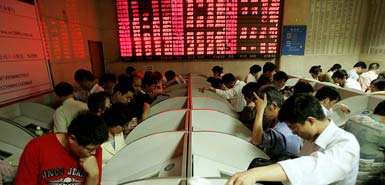 London's leading blue-chip stocks sank to levels not seen in nearly a year today, on the back of heavy selling overnight in the United States and Asia after the credit crunch sparked fresh concern.
The benchmark FTSE 100 index lost as much as 225 points in morning trading, but was trading down 173.4 points, or 2.8 per cent, at 5,935.9 just after the open on Wall Street. Today's decline takes the index below the 6,000 level for the first time since last October. The Dow Jones traded down 91.6 points at 12,769.9 in early deals.
The FTSE 100 index fell 225 points in lunchtime deals, after falling 232.9 points on Friday, the worst one day performance by the index in six years.
Today's fall means that the index, which measures changes in the value of the country's 100 largest companies, has lost 12.4 per cent of its value in a month.
This is one of the fastest falls since the end of the dot-com crisis.
Between May and July 2002, the index lost 1,400 points to 3,800, a drop of 27 per cent.
The magnitude of the fall is likely to raise fresh fears of a prolonged bear market, the description for a market in which share prices are falling.
President Sarkozy of France confirmed that he had written to Angela Merkel, the German Chancellor and G7 chairwoman, suggesting that the G7 finance ministers work with their central banks and the IMF to work towards more transparent markets.
He said that the French and German economies would not experience a lasting impact of the present turmoil.
The fall in London follows a torrid day of plunging stock markets, and ultra-volatile currency movements persuaded trading floors across Asia that, after a decade of lucrative exploitation by hedge-funds, the so-called yen carry trade was now imploding.
The yen carry trade — the practice of cheaply borrowing yen to finance investments across the globe — is thought by some to be the core of the massive worldwide liquidity pool that is now contracting so violently.
The Nikkei 225 index of big Japanese stocks took a 327-point nosedive as nervous investors unloaded holdings of any company deemed likely to have either direct exposure to the American sub-prime debacle or the US economy in general.
The fall in London follows a torrid day of plunging stock markets, and ultra-volatile currency movements persuaded trading floors across Asia that, after a decade of lucrative exploitation by hedge-funds, the so-called yen carry trade was now imploding.
The yen carry trade — the practice of cheaply borrowing yen to finance investments across the globe — is thought by some to be the core of the massive worldwide liquidity pool that is now contracting so violently.
The Nikkei 225 index of big Japanese stocks took a 327-point nosedive as nervous investors unloaded holdings of any company deemed likely to have either direct exposure to the American sub-prime debacle or the US economy in general.
The sudden demise of the yen carry trade, said dealers, is massively exacerbating the prevailing turmoil on global markets.
The panic-stricken flight from equity risk, said one Nomura broker, is producing dangerous chaos on currency markets.
The Bank of Japan, along with other regional central banks, reversed its cash liquidity strategy for a second time in four days, diminishing its sense of being in full control of the situation.
Having drained 2 trillion yen (£8.7 billion) of liquidity from the market on Wednesday, it pumped a further Y400 billion of cash back into the financial system early today.
The behaviour of the US Federal Reserve on Wednesday has brought credit-crunch fears back to the market with a vengeance, said one Mizuho Securities currency trader.
The yen soared against a basket of currencies usually associated with the yen carry trade such as the Australian and New Zealand dollars.
“This is happening not because investors are backing the yen or the Japanese economy, but because we are seeing a wholesale unwinding of the yen carry trade as hedge funds that are being burned on equity markets charge out of their yen positions,” a Nomura broker said.
Other dealers said that some hedge funds, desperate to claw back some profits in a week of carnage, had been creating huge short positions in the currencies that would most be affected by the unwinding of the yen carry trade.
One of the favourite trades was to short sell the New Zealand dollar, following comments by Michael Cullen, the country’s Finance Minister, that the local dollar was still “well above its fair value”.
The overnight slump of the Dow Jones industrial average, and bearish comments by Henry Paulson, the US Treasury Secretary — he said that the present turmoil would “extract a penalty” from the US economy — dealt heavy blows to already dented confidence on Asian markets.
The crisis has hit Japan in a holiday week of traditionally wafer-thin liquidity: traders at Mitsubishi UFJ Securities said that the inability by large hedge funds to unwind their positions immediately was “throwing petrol on the fire”.
Brokers on Japanese and Asia markets described a growing mood of fundamental mistrust that companies in the region have adequately assessed their exposure to the sub-prime problem.
Amid dwindling faith in the credit ratings agencies, which for many are viewed as the pillar of safe investment, portfolio managers reported widespread unease today that many Asian banks, especially Japanese, may simply not realise the risk level of certain investments.
A Merrill Lynch “sell” note on Countrywide Financial further battered confidence that the worst of the sub-prime news had already emerged.
The investment bank speculated that Countrywide Financial, America's largest mortgage lender, could go bust because there was now a question mark over whether it could raise cash in the present market.
Henry Paulson, the US Treasury Secretary, said that the turmoil that has hit the global markets would hit US growth but not push it into recession.
The former head of Goldman Sachs told The Wall Street Journal that the plummeting value of equities, sparked by the crisis in the US sub-prime mortgage market, “will extract a penalty on the growth rate” of the US economy.
But he added that “the economy and the markets are strong enough to absorb the losses” without tipping the world’s largest economy into recession.
Mr Paulson emphasised that the troubles had hit markets “against a backdrop of a very healthy global economy with strong fundamentals".
He added: “Looking over periods of stress that I’ve seen, this is the strongest global economy we’ve had.”
Mr Paulson said that the global economy’s strength marked an important difference between the present crisis and the falls seen in markets in 1998, after Russia’s debt default and currency devaluation and the collapse of Long Term Capital Management, the hedge fund.
(Published by Times Online, August 16, 2007)
_________________________