Asbestos
Workers lose fight for asbestos compensation
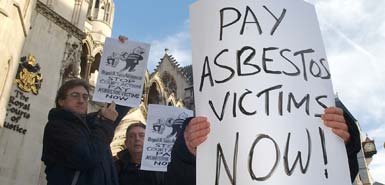 Thousands of workers suffering from an asbestos-related disease lost a landmark compensation battle in the House of Lords today.
Five law lords unanimously ruled that the sufferers of pleural plaques are not entitled to compensation, in a judgment that ends an potential multi-million pound insurance claim.
Trades union leaders immediately attacked the decision to block claims for sufferers of the condition, which is symptomless but often acts as a forerunner to diseases such as asbestosis or mesothelioma.
Passing judgment, Lord Justice Hoffmann said that proof of damage was an essential element in a claim of negligence.
He said that the symptomless plaques are not compensatable damage. “Nor do the risk of future illness nor anxiety about the possiblity of that risk materialising amount fo damage for the purpose of creating a cause of action,” he added.
The decision in a case brought by five victims removes an established right to compensation which had existed for 20 years and will lead to “massive savings” for insurance firms, trades union said.
Derek Simpson, joint general secretary of Unite, said: “This is a harsh decision which will affect thousands of people with pleural plaques now and in the future.
“The judgment will disadvantage many of our members who have been exposed to asbestos in their work by denying them the right to sue their former employers for developing pleural plaques.
“Unite will continue to fight to recoup damages for those people who have developed mesothelioma and other asbestos-related conditions.”
Ian McFall, the head of asbestos policy at Thompsons Solicitors, added: “This decision is very disappointing for the thousands of people who are living with the worry of knowing that their lungs have been scarred by asbestos.
“They will be baffled and offended that the House of Lords has decided that pleural plaques is not worthy of any compensation.”
The ruling today marks the climax of a long-running battle by sufferers of pleural plaques.
When the case went to the High Court in March 2005, a judge found that the plaques did give rise to a claim for damages.
But that decision was overturned at the Court of Appeal after a challenge from the employers involved.
The appeal court judges held in January 2006 that sufferers had not automatic right to sue, even where the condition had been caused by negligence.
It is that decision that the unions appealed and has now been upheld by the law lords.
Martin Bare, president of the Association of Personal Injury Lawyers, said he felt extreme sympathy and sadness for the victims and deep disappointment that the Lords had refused to recognise the trauma and suffering caused by pleural plaques.
“I am absolutely staggered that the Lords have dashed the hopes of these men who have been negligently exposed to asbestos,” he said.
“This ruling effectively tells them that they have not been injured, yet their bodies have been invaded by asbestos and each day the clock is ticking.”
Ruth Davies, of John Pickering and Partners, who acted for some of the victims, said: “This is good news for the insurance industry who will make substantial savings, but a destroyal of the recognition of the suffering of those who have been told that they have scars on their lungs due to asbvestos.”
Steve Thomas, Technical Claims Manager, Zurich UK General Insurance which was one of the insurers involved, said: “In 2004 Zurich decided to bring about this test case because recent advances in medical evidence showed that pleural plaques are not a disease and they do not cause any symptoms.
“Furthermore, they do not develop into any other condition such as lung cancer or mesothelioma.The insurance industry has a responsibility to compensate people who’ve suffered an injury and not to pay out policyholders’ money for a condition that causes no symptoms and that cannot develop into any other condition such as lung cancer or mesothelioma. The House of Lords decision today upholds this philosophy.”
He added that insurers wanted to ensure that those who suffered illness or injury as a result of negligence by employers were compensated.
Individuals with mesothelioma or other asbestos-related conditions will continue to be entitled to compensation, which they are legally due, he added.
“It must be our priority to continue to deal with injured claimants such as these as quickly and as fairly as possible."
The five Law Lords agreed that the appeals should be dismissed because the law does not offer compensation to victims of injuries that cause no, or trivial, damage.
It was agreed that all the men had been negligently exposed to asbestos fibres which had caused a thickening of the pleural membrane surrounding the lungs.
None had suffered any symptoms. But all suffered from the anxiety of knowing that the presence of asbestos fibres in their lungs could lead to life-threatening or fatal diseases, such as asbestosis or mesothelioma.
Lord Hope of Craighead said he shared the regret that the claimants, who are at risk of developing a harmful disease and who have a genuine feeling of anxiety about their future, have no remedy in law.
“But they have not yet sustained an injury for which the law can give them a remedy in damages,” he said.
He said no one can sue for a wrong which has not resulted in loss, injury or damage of a kind that was foreseeable.
“It is the limits of this, most basic, principle of the law of negligence that are under scrutiny in these appeals.”
He said that although the development of pleural plaques may be described as a disease or an injury, they do not normally give rise to any physical symptoms.
All the employers had accepted that if any of the claimants were to develop a harmful disease, they would have an actionable claim, he said.
But to rule otherwise meant that “the smallest cut, or the lightest bruise, might give rise to litigation the costs of which were out of all proportion to what was in issue.”
It has been estimated that hundreds of thousands of people in the UK could be affected by pleural plaques and would have been entitled to claim compensation of thousands of pounds each under the High Court ruling.
The appeals were brought by Norwich Union which acted as an umbrella group for insurance companies to argue that compensation payments for pleural plaques should be ended.
(Published by Times Online, October 17, 2007)
______________________