Menezes trial
Guns officer weeps at de Menezes trial
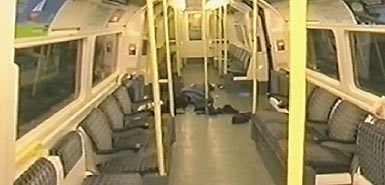 The man in charge of the team of armed officers who shot Jean Charles de Menezes choked with emotion today as he defended his colleagues in court.
The officer, known only as "Ralph", told the Old Bailey that he was "very proud" of his team who, at the time, believed they were risking their lives to protect the public from a suicide bomber.
The Metropolitan Police is accused of a "catastrophic" series of errors leading up to the death of Mr de Menezes, an innocent Brazilian with no terror links. The force denies breaching health and safety laws in the way it shot him.
Ralph was the leader of the team of elite CO19 firearms officers who pursued the 27-year-old electrician into Stockwell Underground station, after being given a "state red" alert to stop him.
He told the court: "The only people running down stairs to confront the man that they believed to be Hussain Osman, a known suicide bomber, were police officers from CO19 and surveillance officers as well, while everyone else was running out.
"We were going forward to deal with this in order to protect the public, even though this man could have had a device on him."
Ronald Thwaites QC, for the defence, read from a statement made by Ralph, in which he pointed out that police officers at the time believed they were risking their lives to protect the public.
The statement ended: "I hope that’s not forgotten."
When Mr Thwaites asked him how he felt about being a prosecution witness, the officer, who was giving evidence behind a screen, choked with emotion and was passed a box of tissues by the court usher.
Trial judge Mr Justice Henriques said: "I think the response speaks for itself."
Ralph said: "Despite the outcome, I was very proud of them."
Also in today’s hearing Ralph told the court that he believed the firearms team would have been in a position to stop Mr de Menezes as he got off the bus and before he went into the Tube station had they been given the instruction to do so.
But they were still at “state green” and had not yet been placed on “state amber” by their controllers. It was only once at this level that Ralph, who was in charge on the ground, would be able to give a “state red” alert to stop Mr de Menezes, he explained.
The judge asked him: “If you had been given state amber sooner, then you would have been in a position to stop him going into the Tube station?”.
“I believe we would have done, yes,” Ralph replied.
Mr de Menezes was killed after being wrongly identified as a terrorist. He was followed from his home at Scotia Road, south London - an address linked to July 21 attempted bomber Hussain Osman – by police who trailed him as he boarded two buses and a Tube train.
He was shot seven times in the head on a train at Stockwell station on the morning of July 22, 2005.
Today the court heard how tests fround traces of cocaine in the bloodstream of Mr de Menezes following his death.
Dr Kenneth Shorrock, a pathologist, told the Old Bailey that a blood test for cocaine was “below detectable levels” but his urine tested positive.
Yesterday the Old Bailey heard how Mr de Menezes was killed by distinctive bullets which cause instant death.
Dumdum bullets cause large exit wounds which "immediately incapacitate" the victim, instead of passing smoothly through the body causing potentially non-fatal injuries.
A senior firearms adviser, who was an acting superintendent on the operation, said the decision to use this ammunition was made to help police chasing the failed July 21 suicide bombers, who were still at large.
The expert, known as "Andrew" to protect his anonymity, told the court: "The bullet flattens on impact and immediately incapacitates the target.
"This is a more effective bullet in the context of dealing with a suicide bomber as there is more chance of incapacitating a subject with a single shot."
The trial continues.
(Published by Times Online, October 17, 2007)
______________________