Musharraf
Court throws out Musharraf election challenges
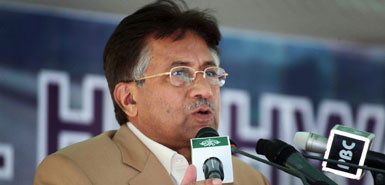 Pakistan's Supreme Court today threw out five out of six legal challenges to President Pervez Musharraf's continued rule, in a move which appeared to bring the President closer to his promised resignation as Army chief.
General Musharraf, who declared a state of emergency on November 3, had said he would quit as military chief of staff and become a civilian ruler once the court had validated his victory in last month's election.
However, despite throwing out five of the legal challenges this morning, the Supreme Court ruled that it would not not deal with the final petition until Thursday, leaving the President's position uncertain for at least three more days.
"There were five petitions, they have all been dismissed. There is only one left and that will be heard on Thursday," Malik Mohammad Qayyum, the Attorney General, told the AFP news agency.
Critics of the Pakistani President claim that he guaranteed the Supreme Court's decision by sacking a number of independently-minded judges who had been due to consider the case when the state of emergency was called.
Despite today's verdict, and a promise by General Musharraf to stand down as Army chief, the rift between Pakistan and its key ally, the United States, showed no sign of easing today. General Musharraf refused once more to bow to American requests to call an immediate end to Pakistan's state of emergency, which he declared earlier this month, or to release thousands of political opponents, lawyers and judges who were arrested when it was declared.
Yesterday, John Negroponte, the US Deputy Secretary of State, urged the military ruler to restore democratic rights before parliamentary elections and stop emergency rule.
“Emergency rule is not compatible with free, fair and credible elections,” Mr Negroponte told reporters at the end of his visit to Pakistan.
General Musharraf, however, retorted that the state of emergency would be lifted only if security improved, indicating that this was unlikely before the elections to be held on January 9.
Yesterday a goverment spokesman said that Mr Negroponte had failed to put forward any new proposals and had received no assurances in return. “This is nothing new,” said Mohammed Sadiq, a Foreign Ministry spokesman. “The US has been saying this for many days.”
Mr Negroponte held two hour-long meetings with General Musharraf on Saturday, but there was little indication that the Pakistani leader would heed his advice.
General Musharraf released the former Prime Minister Benazir Bhutto from house arrest and freed a number of other political prisoners before Mr Negroponte’s visit. But thousands remain in prison and restrictions on the media continue. At the weekend the Government blocked Geo and ARY, leading private television channels that transmit from nearby Dubai.
Mr Negroponte telephoned Ms Bhutto soon after she was released, telling her that America was keen to see opposition figures take part in Pakistani politics. He urged Ms Bhutto resume talks with General Musharraf, underscoring America’s hopes of salvaging the fractious relationship between the two pro-Western leaders. Mr Negroponte asked them to restart talks and ease the atmosphere of brinkmanship and political confrontation.
But there seemed to be little hope that the power-sharing deal could be revived, with Ms Bhutto taking a collision path demanding that General Musharraf quit power.
Ms Bhutto has already ruled out negotiating with the President to form a coalition government to end the country's political crisis regardless of the Supreme Court's verdict, vowing to form an alliance with other opposition parties to defeat him.
It was not immediately clear if one of the election appeals, originally filed by the vice-president of Ms Bhutto’s party, Makhdoom Amin Fahim, was one of the five that the attorney general said had been dismissed.
General Musharraf had cited growing Islamic militancy as the main reason for imposing the state of emergency on November 3. But analysts and human rights activists said that most of those targeted were moderates, not extremists.
Mr Negroponte also met General Ashfaq Kayani, vice-chief of army staff, who is expected to replace General Musharraf as army chief. Observers said that the meeting signaled US support for the general, who is known for his pro-Western views and who worked closely with US intelligence agencies in his previous position as director-general of Inter Services Intelligence, Pakistan’s security service.
There is concern in Washington over the repercussions that political instability in Pakistan could have for the War on Terror and regional security. General Musharraf, who seized power in 1999, has been a key Western ally in the region.
Yesterday Mr Negroponte praised General Musharraf’s efforts in the fight against terrorism. “President Musharraf has been and continues to be a strong voice against extremism,” he said. “We value our partnership with the Government of Pakistan under the leadership of President Musharraf.”
Three days of sectarian violence between Sunni and Shia Muslims have left 91 people dead in a northwestern Pakistan town. Both sides fired mortars and weapons at each other in the town of Parachinar, targeting residential areas and hitting mosques. The military said that 80 civilians and 11 security personnel were killed.
(Published by The New York Times, November 19, 2007)
______________________