The Brazilian labour legislation in its three fields of study - the individual labour law, the union labour law and the procedure labour law – was significantly altered on November 11th of 2017 with the approval of Law 13.647. The Consolidation of Labour Laws, the first compendium of labour laws, dated 1943, was substantially altered, as was never before, due to an urge for the flexibilization and modernization in labour law, in addition to a need for reducing the labour jurisditional demands of the courts.
Changes in the working-day which have been perpetrated in the Labour Reform stand out in the field of individual labour law. Before the reform, the hourly compensation could be annual or weekly, the latter is statedd by an individual agreement, between the employee and their employer, to compensate a working-day on Satuday or reduce the working days in a week; the former is agreed with the union. Hence, the annual compensation could only be validated by a collective agreement with the employees. Unlike the latter legislation, workers now can negotiate working-day compensation not only collectively but also individually, for a six-month period, in which the employers decide, according to their needs, when the workers will extend their working-day and will receive their day-off or reduced working-day. Another important change in compensation working hours was made in the 12 x 36 shift, in which a 12-hour working-day is alternated by 36 hours of rest. As opposed to the former legislation in which the 12 x 36 shift could only be negotiated by the union, in the recent legal text, this special working-day can be agreed by an individual agreement.
It is notable as well that the concept of salary has changed in a way that some payments which usually were atributed as “bonuses” or “wage premiums”, included and reflected in the total salary, will no longer be included, since the reformed law atributes to them an indenizatory nature. This is expected to end the eternal court discussion surrounding the nature of bonuses and premiums. Furthermore, it motivates employers to pay those quantities, as they are not incorporated in the total wage and these other payments, such as in holiday payment and in social security contributions.
In conclusion, the labour reform consolidates direct negotiations between workers and employers as a measure of flexibilization in relation to the individual labour law.
Concerning the union labour law, the negotiated norms, which are celebrated between union and employers, will prevail upon the governing law in some subjects that are stipulated in article 457, paragraph 2 of the Consolidation Labour Laws, even if the collective dicreases the guarantee of worker’s minimum rights. However, in Labour Law, a specific principle in this field of study prevails: the Principle of the Most Favourable Norm, which means that it does not matter the hierarchy of the norm, if it is in the Constitution, in an inferior legislation, a private employer’s norm in their internal regulation, it will be applied the most favourable norm to the employee’s benefit. Labour Law dos not follow the same logical rules of other legal fields, such as the application of a more specific norm rather than a general one, or a superior norm in the hierarchy, because its basic purpose is to protect employees against the economical power of the employer. Therefore, the article reformed aforesaid, which stablishes that some subjects, if negotiated by the union in a collective convention, will prevail upon other norms, is certainly opposed to the minimum protective principles in Labour Law. Furthermore, a worker’s right cannot be renounced, but it can be interchanged for other guarantees, if this right is not about health and security issues, such as holidays, days-off, usage of protective equipment. In this way, a practical and constitutional application of this new legal disposal, for instance, is reducing the lunch break time, which in the legislated law must be taken stricktly in an hour, considering a more than 6-hour working-day. The legal reform permits that only unions can fix a reduced lunch-time break, but with a caveat, such as a reduced daily working-day or a higher percentage in overtime working hours.
In contrast to the previous legislation, in which labour lawsuits were mostly litigious, the new legislation prescribes some voluntary jurisditional procedures, which means that both parties, employee and employer can submit a termination agreement to a labour court, thus providing promptness to the contract ending. Moreover, there is a new type of termination, beyond the dismissal, in which the parties consent to rescind the labour contract. In this case, the worker will receive the integrality of its remaing rights, but half of the value of prior notice, which varies from 1 to 3 salaries, depending on the contract length, and half of the indenization payed upon the total amount of the guarantee fund for time in service. Not as a condition of its validity, but as a measure to completely grant discharge to the labour contract, the parties can submit the termination, in a voluntary procedure, to court homologation.
Besides introducing this new type of jurisditional procedure, the labour reform lays down the obligation of paying fees to the subjects that the party is defeated, even if the party is economically disadvantaged in the legal concept, which, indeed, have been altered to restrict the possibilities of obtaining the right of free justice, only for the workers who receive less than 40% of the higher benefit payed by the Social Security, unless the worker proves, in another way, to be in an economical disadvantage. One of the purposes of this restriction was to exclude workers who gained high salaries, of receiving free justice, since, according to the former rules, by only self-declaring, the party could be considered economically disadvantaged. In essence, unlike it was before, those new procedure statements, avoid unwarranted labour lawsuits, as long as the party has to bear more costs and fees.
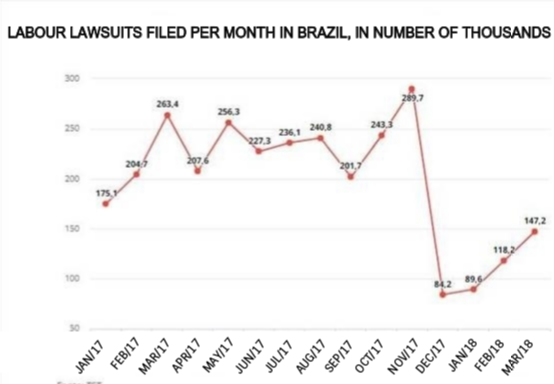
Finally, it is important to emphasize that, in spite of the legal changes, some of them are apparently contradition to the Constitution, and the Superior Labour Court has not pacified its application yet. However, one of the main purposes of the labour reform has already been accomplished, as the labour lawsuiting has significantly been reduced, according to research done by the Superior Labour Court in May of 2018:
______________________________
*Victoria Catalano Corrêa Guidette is a lawyer at Cerdeira Rocha Advogados e Consultores Legais.