The legal auditor before young people
Jayme Vita Roso*
Everything would perhaps level out into perfection, if only we were given a second chance.
Goethe[1]
Part I
Introduction
 1. Having been called upon to act as part of a multidisciplinary group to discuss proposals that would be offered to the governments of the industrial municipalities known collectively as the ABC region, located in greater São Paulo, with the purpose of creating opportunities for young people, preliminary meetings were held in which each of the participants offered suggestions as to the work they would pursue. The final reports of such participants were to be submitted at the closing meetings.
Taking that same familiar path that culminated in “Direito em Migalhas”[2], our research was to address facts that happened, and are happening still, to young people. I would like to mention in advance that writing a report on young people with a view to inserting them into the labor market is, in itself, an arduous task, given the precariousness of the existence of some topics essential for the compilation of our information tables and as many analytical diagnoses as necessary, in order to reach a decision on public policy.
Any deficiencies would have to be filled in, because comparing the aspirations of the young with the possibility of transforming such aspirations into positive concrete action would also have to be the focus of our research.
Each participant of the group chose a focus and made a list of the major concerns of the young and, alongside them, in the same universe, the major concerns of young lawyers. To the latter, I devote endless affection, because I feel the pulsing of their anguish when they seek traineeships and, soon thereafter, professional insertion into the market.
A warning.
Any legal auditor working in a multidisciplinary team must be careful when drawing up the document that all his other companions will sign and in which the individual tasks are determined.
The precision of the language, the origin of the style and the clarity of the rights and obligations of those involved should be the object of pursuit regarding the document in question. Every amount of care would also be taken over any other cautionary renderings, among which, those related to confidentiality.
2. In the capacity of legal auditor, I ignored relevant texts from other spheres of human knowledge in order to concretely attach myself to those social facts - namely education and culture - that reflect and rebound upon the legal world, because, with the advent of globalization, conflict with the sociolabor and sociocultural worlds, not to mention with others of note, is now underway.
Practical discourse in general and the rationality of the praxis of the legal world repose upon - and not only upon - analogy. And analogy is conceived as an inferior level, the most elementary of levels, that will outline the structures of similarity, relation, coherence and proportionality[3] when any judgment of value is formed.
The purpose of the work is specific to lawyers who are trained in, and familiar with, legal sociology and anthropology. It is work to which the legal auditor, fastidious to a fault, must never fail to be attentive, and it must be emphasized that this branch of the practice of law requires and demands a trained professional because, to the contrary, he would not be qualified to investigate, having neither method nor the adequate preparation.
2.1. Given that the involvement and the interaction between the group of young people and the subgroup of young lawyers is inexorable due to globalization, the use of analogy in the preparation of the report is pertinent.
3. After conducting a bibliographic search in institutions, agencies, libraries and other places specialized in employment for the young, and even in IPEA (the Institute for Applied Economic Research) and DIEESE (the Inter-union Department of Statistics and Socio-economic Studies), both of which are technical departments connected to the Labor Ministry, I went to the book stores of the World Bank and the International Bank for Reconstruction and Development in search of the most recent of publications, Development and the Next Generation[4].
4. This is a lengthy piece. Since it is a work that can be used for multiple purposes, and since my other team mates all had well-defined tasks, my best option, or the one that seemed to me to be the most convenient, was to synthesize the predominant ideas that anchored the differing and converging suggestions or propositions or arguments. I used, in this task, the revealing topics of the urgency with which positive attitudes should be taken and the necessary changes should be made, with determination.
3.2. In the introductory part (the Overview), pages 1 to 24, the authors are emphatic and urge: “Invest in Youth – Now”, and then go on to mention the policies for young people that must be adopted and practiced: (a) to focus not only on giving opportunities to young people but also on their capabilities and second opportunities; (b) to widen their opportunities; (c) to increase their abilities in order to transform them into people who are able to make decisions and (d) to offer them second opportunities. All these actions have one objective: that of moving forward.
3.3. The first part of the book has the appealing title: “Why now, and how?”
Right away, the theme is divided into two chapters. In the first, “Youth, the Reduction of Poverty and Growth”, young people are courageously called upon because, as players, they are necessary for progress, with the reduction of poverty and with growth. It also examines how challenges involving young people have changed shape, and how demographic alterations (with the increase in the population) affect young people, and whether or not they are prepared for these changes. This first chapter closes with a question that is disquieting for those who are concerned with this phenomenon: how should the politicians in charge of this strategy act?
Pausing awhile to reflect upon this question, the authors remember that young people should, in order to fulfill their potential, contribute to their own well-being and to that of the society into which they are inserted. They need to continue learning in order to build up their own work expertise or skills, because they need to accept and manage the dimension of the risks to their health. They also need to be suitably prepared to become parents with the objective of reducing the intergenerational transmission of poverty, which occurs by virtue of a complete breakdown in family planning, in the space in which births take place and in the position of the needs of children. And they also need to learn to engage, as citizens, in the communities and societies in which they live.
These various steps are known, in Anglo Saxon literature of social sciences, as the “five dimensions”, or rather, “learning, going to work, staying healthy, forming families and exercising citizenship”. These different stages are presented in an individual way; they are transition phases in the life of the young person, but each one has its own peculiarity and identity: there is a certain constancy, to my mind, but such constancy cannot be considered to be unanimity.
3.4. In the work, the five phases of the transitions are developed over one hundred and twenty pages, in order to thoroughly focus, on a case by case basis, on the so called hypotheses.
Between Part I and Part II of the book, there is no redactional identity, but, because transitions or periods of temporal/personal mobility are at issue, each phase has its peculiarities, especially given the fact that the approach is individual (on a country to country basis) and global. The data need to be gone over one by one and, later, need to be compared to others, regardless of whether they are from the same geographical region or not.
Regarding Part II, it behoves the legal auditor to give the reader of the work knowledge of a spotlight specially written about the youth of Brazil, and to add depth to the data and information, set down on eighteen pages, on the exercise of citizenship that interests, above all, young lawyers.
A) On pages 142-143, the text On the Disparities Between Young People in Brazil is set out:
“Persistent inequality is one of the greatest concerns that a growing economy advancing toward the reduction of poverty can have. The inequality present in the results of human development among Brazil’s youth puts a progressive future at risk. But, specifically, a lack of labor and educational opportunities for minorities only reinforces the transmission of poverty down through generations, leading to constant inequality. Brazil is developing an intersectorial approach with the objective of breaking this cycle.
Brazil, the industrial power with the largest population in Latin America and the Caribbean, has made great inroads in reducing poverty, which continues to afflict millions from within its population. The indices of enrollment in basic education and further education are equally positioned in relation to other Latin-American countries such as Colombia and Mexico, but the averages hide the disparities that affect millions from among the young population.
-
The young people (15 to 24 year olds) in the poorest ten percent of the population have a formal sectorial employment rate of 4%, which represents an eighth of the national average for this age group – and it does even not reach a tenth of the national average of the adult employment rate. In contrast, those who are in the richest ten percent enjoy a formal sectorial employment rate of 50%, a third higher than the national average for the age group.
-
The young people in the poorest ten percent of the population have an illiteracy rate of 14%, which is equivalent to three times the national average (by the age of 12, half of the youths from the poorest families have left school). The illiteracy rate corresponding to the richest ten percent 0.3%.
Due to the fact that inequalities in opportunity are easily transmitted from generation to generation, investing in the young population is fundamental if the strategy for reducing poverty in the long term is to be a success. A recent analysis involving the major studies in homes shows that more than a fifth of the total of unequal income in Brazil can be explained by four variables: the schooling of the parents, the profession of the father, race and region of birth, and the human capital of the parents, this latter being the most relevant.
Brazil is seeking to deal with these inequalities by taking, as its direct focus, underprivileged young people, and by coordinating measures, from a variety of sources, aimed at solving the problem."
Main focus: underprivileged youths
Brazil has a rich portfolio of public and private programs aimed at expanding opportunities, improving skills and offering new chances to young people. It is guaranteeing wide access to specific medication for the treatment of AIDS, which is part of an anti HIV/AIDS strategy considered internationally to be a benchmark. With regards education, the country is earmarking more funding to municipalities in order to solve the problem of high repetition rates at school and the bad quality of school services at the high school level. It is also beginning to look for reactions that involve transitions and sectors by way of the Bolsa Família (Family Allowance), ProJovem (ProYouth) and Abrindo Espaços (Opening Spaces) programs, as well as health education programs directed at men and women alike.
Bolsa Família (Family Allowance Program)
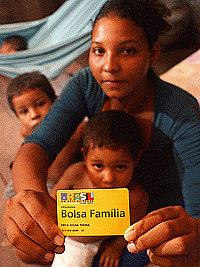 For many mature students, the cost of the opportunity to attend school is high. They do not see much benefit in staying at school much beyond the few years of basic education, and the income they give up and lose out on because of this can be expressive. With a view to relieving both the direct costs as well as the costs of opportunity, Brazil has been one of the first countries to conduct an experiment on the direct transfer of resources linked to the condition of school attendance.
The Bolsa Escola (School Allowance Program) first arose on the state level; the purpose of this program was pay out a monthly financial benefit to families whose children were all between the ages of 7 and 14 and were all attending school. School attendance rose more for the beneficiaries of the program than it did for the control group. In 2001, the program had expanded to the national level and in 2004 the federal government launched the Bolsa Família (Family Allowance) program, tying the Bolsa Escola program in with other conditioned fund transfer programs. Although an assessment of the impact of the Bolsa Família program is just beginning, a study conducted in 2005 concluded that for those in the 10% of the population with the lowest income, this benefit could make 11.5% of a difference in school enrollment. In order to expand the program to older youths, the government has been discussing the possibility of adapting the education incentives that the Bolsa Família program offers by implementing the following measures: a) offering a bonus to those who complete high school, b) increasing the amount of the transfer to those young people from an older age group who stay on at school (recognizing the greater cost-opportunity of this group), or c) extending the conditions of school attendance to young people between the ages of 16 and 18, which would attract enrollment in high schools (or a combination of all three).
ProJovem (ProYouth Program)
The Brazilian government acknowledges that young people who leave school may want to improve their education. Indeed, approximately 20% of working young people go back to school. The Education for Young People and Adults program is an educational course for adults geared toward making literate those adults and young people who have interrupted their studies. Additionally, a new program, ProJovem (ProYouth), is being tested. It goes beyond teaching young people (18 to 24 year olds) who have left school basic reading and writing skills. It offers a complete curriculum that covers mathematics, languages and preparation for the exercise of certain duties and citizenship, amongst other subjects; a two-week voluntary project; and general and career support services for young people while they participate in the program and immediately after they complete it.
Abrindo Espaços (Opening Spaces)
It is believed that exclusion is behind, and also a cause of, violence among the young. The Escola Aberta (Open School) program in Pernambuco, which began in 2000 as a partnership between the local government and UNESCO, keeps schools open on the weekends in the poorest and most violent neighborhoods, offering children and young people a variety of cultural and sporting activities aimed at keeping them off the streets and allowing them to express themselves peacefully. A study conducted by UNESCO shows that those schools that took part in the program experienced a 60% reduction in violence. The program, which has become known as Abrindo Espaços (Opening Spaces) has, since that time, expanded into the states of Rio de Janeiro, Bahia, São Paulo and Rio Grande do Sul, and has shown positive results. Additionally, schools that adhered to the program at its outset have shown the greatest success thereby suggesting that a greater impact can be had over time.
Health Education
Given the precocious sexual initiation among young people, together with risky sexual behavior (defined as the failure to use contraceptive methods) programs that deal with questions related to young people are of special relevance in the prevention of pregnancy in adolescence and in the proliferation of sexually transmitted diseases. In 2003 the Health and Education Ministries launched a controversial pilot program to distribute condoms to schools in five municipalities. In 2004 the program was expanded to the 205 municipalities that are responsible for almost half of the cases of AIDS in Brazil. The program has the additional advantage of preventing teenage pregnancies, which today is responsible for 25% of all births in Brazil. The program was expected to reach 900 state schools, attended by approximately half a million students. Although this initiative, in particular, has not been the object of assessment, similar programs aimed at the population in general are part of Brazil’s wider and successful strategy against the rapid dissemination of AIDS.
Gender: what the boys think
Precocious and unprotected sexual behavior is frequently attributed to the roles played by both sexes: the boys trying to prove their masculinity, and the girls, their bargaining power to negotiate the situation. Instead of making the girls responsible, as so many programs do, Program H in Brazil is working to offer greater orientation to the boys, altering their way of thinking about the different roles and behaviors of both sexes, in the hopes of changing their sexual choices and expectations.
The program was evaluated in three shanty towns (favelas) in Rio de Janeiro, whereby two of the favelas were implemented with the program and the third wasn’t. According to the evaluation six months after the conclusion of the program, there was more use of condoms by the participants in the program, a lower rate of new sexually transmittable infections and a significant improvement in the scale of Men Made Responsible by Gender, relative to the control favela. Although some failure of methodology was detected, the Program H experiment has shown that its approach is promising as concerns healthy sexual behavior.”
Coordinating policies aimed at young people in a state of poverty in a highly decentralized state
Brazil has recently begun taking measures to improve the coordination of the various agents that put into effect policies for young people:
·The recent creation of the Youth Agency allows a centrally oriented agency strategically located within the General Agency to facilitate collaboration between ministries and develop a national strategy. Focusing on the development of national priorities and guidelines that allow action to be taken on a local level through technical and financial support, its objective is to raise public and private funding so that maximum impact may be had. Other ministries are doing the same thing with their own strategies for the young.
·Young people themselves are mobilizing both on both the community and national levels. The recently created Vozes Jovens (Young Voices) program has developed a proposal for a policy geared toward youths on a national scale. This group of leaders of Non-Governmental Organizations that work to the benefit of young people not only strengthens the NGO movement but also gives young people an active voice on the national scene.
·State and municipal governments have developed strategies for young people and are earmarking federal funds, as well as their own funds, to local civil organizations and companies in the private sector so that programs may be implemented. Better coordination between the states and the municipalities in terms of defining target groups, priorities and the division of labor at every level of government will allow for more efficiency in the provision of services to be achieved. For example, the Brazilian federal government is using fiscal and expense incentives in municipalities and states to increase the number of high school enrollments using a financing mechanism known as FUNDEB (Fund for the Development and Maintenance of Elementary Education and Recognition of the Teaching Profession).
·NGOs are already very active in implementing programs and in responding to the government on all levels. The help that is given to help reconcile local priorities, the stimulus to work that is offered by NGOs using government incentives and support (financial and technical), as well as the improvements to the design of the program by developing monitoring and evaluation systems will, furthermore, improve the role of civil society.”
B) The exercise of citizenship plays a decisive role in the life of the young lawyer[5].
An unexplored field in the exercise of the practice of law is the role of the lawyer in lawsuits where citizenship is debated or criticized (especially where political or environmental rights are concerned).
Is participation growing or declining, in this area – the authors ask – or in both?
Young people have countless opportunities for political participation and active citizenship. While, on the one hand, the young are more willing than the old to give up resources to prevent environmental pollution, or show up for elections, on the other hand, they do not have sufficient motivation to participate in community or voluntary work. The information highlighted below, which is extremely captivating, on the work of Jorjão in Rio, is reproduced for the readers’ appreciation:
“Jorjão’s citizenship – from youth to adult life
Jorge Paivo Pinto (which, we must point out, is not his real name), otherwise known as “Jorjão”, went from a small town in the Brazilian northeast to Rio de Janeiro when he was 16 years old. He was the fifth son of a family of 19, out of which 9 died from malnutrition. His parents were illiterate rural workers and he never went to school. He traveled the country when he did his military service, an experience which awakened his political conscience.
While he was still a young man, he was among the first trespassers to occupy a settlement of land in the industrial north zone of Rio, and spearheaded a struggle against their eviction. Until 1968 he was a very respected leader within the community and led demonstrations demanding electricity, water, basic sanitary infrastructure, the paving of roads and the building of concrete steps up the sides of the embankments.
The citizens of Rio had previously lost the right to elect their mayor, governor and president, but they were still able to elect their city councilmen. Jorge kept his position as president of the Residents’ Association and negotiated with the city chamber on behalf of the community. With the restoration of democracy in 1984-85 and the actions of the citizens, not-for-profit organizations and political parties began to proliferate. It was then that drug trafficking began to appear in the favelas (shanty towns). It looked as thought the police were protecting the rich neighborhoods and turning their backs on the poor favelas, and the favelas were later to become the chosen points of sale for the drug trade.
The trafficking of drugs attracted both money and weapons to the favelas, and the drug traffickers went on to exert greater influence over the community and assume control of the Residents' Association, community organizations and even the local school. Jorge was forced to move to a region far from the favela, but continued to improve the life of the community by fighting for a health clinic, a day care center for children and better quality teaching - and to be a respected leader, a fact that further irritated the drug traffickers.
The street lights on his road were shot at every night. Bullet holes perforated the water tank in his roof and filled his house with bullet marks. Gangs of young drug addicts would gather at the front of his house. Finally, in 2004, after several death threats and many appeals from his family, he decided to move.
The majority of people interviewed in the favelas of Rio do not feel themselves to be citizens. They do not even feel themselves to be people. The experience has taught them to act cynically. The police are not held responsible for any extrajudicial action, not even for the homicides, and the legal and police systems are "accomplices in the maintenance of the privileges of the privileged", as Jorge's son explained.
Source: Perlman and Antony (2006).
If, once they have attained an identity and space within society, young people come to feel the need to have a second chance legally recognized, individual progress will have been achieved, which will then be extended to the collective whole.
4. In Part III, Across Transitions and Next Steps, the book draws to a close, primarily, by considering the pungent theme of international migration and that of the intriguing global flow of information and ideas, as concerns young people.
Part II
Suggestions
5. This Brazilian legal auditor alerts the authorities, by clarifying that:
(i) the priorities of the policies aimed at young people perforce vary from country to country;
(ii) policies aimed at young people often fail;
And, to conclude, with emphasis, he appeals thus to governments:
(a) do you job with diligence, developing a coherent armor and integrating it into national policy;
(b) do your job while listening to young people, and
(c) do your job, completing it with periodic monitoring and assessments, setting an example of sobriety, effort, good will, transparency, ethics and a love for your country. Herein lies the crux of the work that the team is performing and will propose to the contracting authorities.
Part III
Conclusion
By informing that the hiring of the team and the legal auditor obeyed the regulations and legal rules that are pertinent today, his last observations may be set forth.
Given his education and training, the legal auditor, after concretely assessing hundreds of facts and myriad information, will report how much is required for his observations to be discussed and to be taken to the forum at which the conclusions of each team member will be related.
With discernment and balance, the legal auditor will attempt to demonstrate that complacence, indifference and utilitarianism have been – as well the epigraph shows – the greatest evils that assail the youth of today; and this explains the pragmatic signing off of the book: “It’s up to you(th) – taking action for development”[6].
Research References
Below, valuable sites that may be consulted in connection with the content of this article:
https://www.worldbank.org/wrd2007
https://www.worldbank.org/consultations
https://www.worldbank.org/childrenandyouth
https://www.onderwijsraad.nl/Doc/English/masterofmarket.pdf
https://www.usnews.com/usnews/biztech/articles/060403/3worldbank.htm
https://www.jobsnet.lk
https://www.comminit.com/experiences/pds62004/experiences-1983.html
https://www.worldtracker.com
https://www.enlaces.cl/libro/estadisticas.pdf
https://eric.ed.gov/ERICDocs/data/ericdocs2/content_storage_01/0000000b/80/27/39/7a.pdf
[1] Text by Goethe: “Es liesse sich alles trefflich schlichten / Könnt mann die Dinge zweimal verrichten”. Quoted in Benjamin, Walter. Reflections on Children, Toys and Education. São Paulo: Editora 34 – Livraria Duas Cidades, 2002, p. 101.
[2] ROSO, Jayme Vita. “Direito em Migalhas: Pistas Para o Novo Mundo Jurídico”: Campinas: Editora Millennium, 2006. 450 p.
[3] SALGUERO SALGUERO, Manuel. Argumentación Jurídica por Analogía. Madri: Marcial Pons, 2002. 275 p.
[4] World Development Report 2007: Development and the Next Generation. Washington: The World Bank, 2007. 317 p.
[5] This is how citizenship in defined in modern times: The status of citizen was in direct contrast to the condition of slave and to the condition of others who supposedly were not capable of using reason to define the destiny of communities. The ideal of citizenship, further, in many moments and places, emphasized equal participation in the community and obedience to it, promoted integration into social life and established a zone defined as private life, which was a state that should not be violated. Citizenship was also the banner of a shared way of life and of a willingness to defend it against the interference of strangers. Today, citizenship is frequently used to suggest human dignity, and many of the social and political movements, such as those that preach the right to health care and education, are set up in an endeavor to give more support to citizenship. Rights associated with citizenship, especially in developing countries, have expanded in recent decades, and have gone on to cover the requirements of liberty - social and economic assets such as jobs and access to basic services - and are not limited only to political and civil rights and immunities.
This is the ideal of citizenship. The reality, evidently, has always been, and still is, more complex. For example, the so-called de facto legal rules, in a large part of Africa, attribute rights - relative not only to questions connected with religion and the family, but also with real estate ownership and economic opportunities - to the chiefs of ethnic and linguistic groups and not to individuals. This practice reflects the colonial distinction between the individualistic rights of the urban population and the rights based on the notion of the group, attributed to the “peasants“.
The two main elements of contemporary citizenship – shared identity and rights - are coming apart to the extend that foreigners who live as legal residents gain the right of access to basic public utilities (in addition to the right to vote in national elections in Chile, Malawi, New Zealand and Uruguay) in the same proportion that the number of illegal foreigners, the homeless and refugees rises, and to the extent that countries seek export processing zones and other areas with different rights and obligations.
The ideal of universal, egalitarian citizenship does not specify the relationship between the state and ethnic minorities. Should sub-national administrative and electoral limits obey ethnic/linguistic divisions? And which languages should be taught in school? Some states deprive ethnic minorities of national citizenship in order to free themselves from the cost of providing services to groups that do not sustain the dominant regime, creating hundreds of thousands of “orphans of the state” in the past decade. In many countries, women continue to come up against cultural barriers – sustained by legal relief – that prevent them from owning and inheriting real estate, participating in political life or having access to education.
[6] World Development Report 2007: Development and the Next Generation. Washington: The World Bank, 2007. p. 225-226
__________________

*Attorney at Jayme Vita Roso Advogados e Consultores Jurídicos